Tuesday, February 8, 2011

Highway To Hell (Kenya to Uganda)

It began like any other day in East Africa, a painfully early morning cab ride to the intercity bus station (in this case inter-country) for our scheduled 10 hour trip from Nairobi to Kampala, Uganda.  This was well within our defined 12 hour bus trip limit we had set for ourselves and the coach even had reserved seating.


After being in Kenya for eight days, it seemed an oversight for us to just notice the street cages set aside for public smoking – Kenya seems to be among the first nations to ban such activities save for these defined enclaves.  We were also remiss to notice that the bus route pretty much duplicated the first three hours of our return trip from Lake Nakura (which means we could have stayed there, avoided two three hour journeys and caught this bus at the civilized time of 11am).

Then things really started to degenerate.  Our bus was stopped at, what had been up to then, one of a hundred perfunctory highway traffic stops, but this time the officer made us turn around and drive, with her aboard, back to the town police station.  It seems corruption has not totally been eradicated, as the bus was to be fined for a broken windshield (we’re not sure, but we can’t remember seeing a bus without a broken windshield).  Then the officers came on board to search for other potential safety violations in an effort to pad the offences into an even larger fine.  How surprising when they found most seatbelts and many windows non-operational.  Meanwhile, the indigenous passengers, most likely used to this sort of thing, taking it in stride and using the stoppage as an opportunity to relieve themselves – finding privacy behind the bent and mangled vehicles of the traffic accident compound.


A half hour’s worth of fine enhancements and we were back on our way, but the sinister signs were all there.  Four hours later (total seven hours so far) – we reached the border.  Just as we were to disembark for the Kenyan immigration exit extravaganza, the sky (which to this point was blazingly sunny) turned an ominous grey and torrential rains soaked the poorly draining area.  All windows now closed on the non-air conditioned bus for the five minute drive to the Ugandan entry immigration post.  Passengers scurried in the downpour, mud slapping at every turn, many slipping and falling, and then a power failure.  We were the only Mzunga on the bus (a southern, central and eastern African slightly derogatory term for "person of foreign descent" - more recently coming to mean "language of the aimless wanderers" ), and we were therefore responsible for holding up departure awaiting our required entry Visas.


And we were off!?  Well, not so fast.  There was a line of about transport trucks five kilometers long now blocking our passage – eight hours and counting. 


Our bus bobbed and weaved his way through in only an hour.  So, why can’t we traverse the nearly 250 km left in one hour, it had only taken us only nine hours to come the 330 km so far?

We passed one unattractive rural town after another until sundown then streams of roadside stall and shop lighting emanating from lanterns and compact fluorescents for another eight hours.  Some Sunday traffic entering Kampala slowed us a bit more (must be those folks returning from the cottage) and the finally tally was 17 hours for our 10 hour max. bus ride.


Arriving anywhere at 11pm to an inner city bus terminal is sub-optimal, but a third world capital is actually worse.  Despite the hour, a throng of service providers (read touts, taxi drivers and all round “operators”) closed in on us.  After 17 hours, courtesy was tossed aside and we donned our backpacks and bolted.  After another hour of wandering through central Kampala (our new champion of ugliest world Capital visited, displacing previous co-leaders Vientiane, Laos and Asuncion, Paraguay), we managed to find an ATM and a hotel.  Maybe a shower and some sleep will expunge today’s memorable journey…There has been a bus trip story from hell on every one of our extended travels; let’s just hope this is the “one”!

Friday, February 4, 2011

Talk to the Animals (Kenya)

So where else do you find a giraffe in the distance as you exit the international airport parking lot?  Yes, this is East Africa – Nairobi, Kenya specifically.  After some much needed $US replenishing at some “real and recognizable” UK banks, we were ready to pay for our 4 day national park safari, leaving the very next morning.

We drove for a bit over an hour before descending into the rift valley and a quick stop to join in with a couple from China (by way of Saudi Arabia – where they are grad students, yeah, we were a bit perplexed as well).  Three more hours of bumpy, potholed “highway” and we were at our tented camp home for the next three days and two nights at Masai Mara National Park (a large canvas tent under a permanent lien-to with zippered access to a concrete and tile bathroom, an actual wood frame bed / mattress and generator electricity from 7 – 11pm and 6 – 9am…luxury). 

 
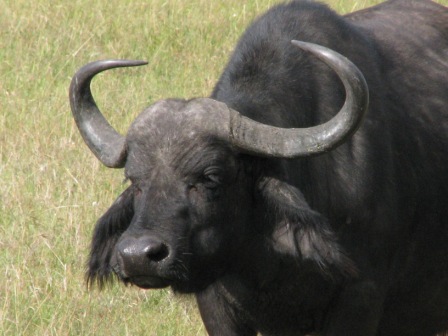
Then it was time for our late afternoon / dusk game drive – and our Safari intro was no disappointment.  Seconds into the gate we encountered Zebra, Impala, Masai Giraffe, Wildebeest, Hartebeest, Topi, Buffalo, Elephant, the small but necessarily fast Thompson Gazelle, and a myriad of birds (Guinea Fowl, Vulture and Secretary Bird).


The CB radio then started buzzing with Swahili excitement and we took off in the direction of dust clouds (it seems the best way to find wildlife in National Parks here is the same as in Canada – check for the cluster of cars at the side of the road, only difference is that here the cars are 4WD safari trucks).  We approached more slowly and promptly established what all the fuss was about – a family of Cheetahs sauntering about virtually ignoring the throng of vehicles and simulated digital camera shutter snaps, and then a second “coalition of Cheetah” (hey that’s the name) emerged nestled on a rocky outcrop. 


Our Chinese friends were still recovering when we heard a loud gasp - a small pride of lions wished us well en route to the park exit, a fitting way to end our first day.

We spent the next day exploring the nether reaches of the park with the following new animal encounters:
  • Bat-Eared Fox, Mongoose, Warthog, Hippo, Crocodile, Tortoise and for the fowl - Ostrich, Eagle, and Crowned Crane. 
  • We stumbled on a sleeping pride of Lions – this time with an adult male and his magnificent full mane.
  • Two Masai Giraffe started entangling their necks – which we mistakenly believed to be affectionate, but based on the increasingly aggressive neck whacks we determined that they were two males actually competing for the affection of a nearby female.  

That evening we took a short stroll over to explore the nearby Masai village where many of the young men in traditional garb performed a traditional dance (more like a grunting and jumping contest that they couldn’t resist having me compete in).  Being invited into one of their mud huts was eye opening, as this 150 square foot abode was actually subdivided into four living quarters, housing as many as six family members with one of the rooms reserved for the animals at night.  Moreover, the useful life of this modest accommodation is only six years.  


We couldn’t have imagined anything fresh on the final dawn game drive (pre-dawn the next morning), but we were wrong, dead wrong.  Oh great, another two lions, ho hum, but what’s that carcass doing there?  Yes, right out of National Geographic, a lion was dragging one of two freshly killed Topi behind some bushes for safe keeping.  The first had already been consumed, as evidenced by the White Headed Vultures finishing it off a few metres away.  Other notable additions include: Dik Dik, Black-Back Jackal and Servile.


Another 6 hours of driving was required to reach Lake Nakuru National Park, an alkaline lake supporting a vast aviary population and a few more animals to add to the checklist, including one more of the Big Five – a White Rhino, as well as
  • Olive Baboon, Waterbuck, Rock Hyrax, Rothschild Giraffe, Vervet Monkey as well as Flamingo (pink and white), Stork (Mariboo, Yellow-Billed, Saddle-Billed), Pelican, Egret, Heron and Plower.

Four out of the big five – maybe Tanzania will provide the elusive Leopard.

We also learned that most of these Savannah fauna are herbivores, but it was the carnivorous cats that left that lasting impression.  So, we returned to Nairobi and immediately had a dinner of as much meat as possible – at least we didn’t have to hunt and kill it ourselves.

Safaris really are all about the photos - check out our faves on flickr at:
http://www.flickr.com/photos/thegoobers_pics/sets/72157625975419724/

Monday, January 31, 2011

Time Passages (Ethiopia)

We hooked up with a group of men made up of three Spaniards, one Italian and an American for the 5 hour joint loosening bus ride for two days of high altitude hiking on the escarpment of the Simien National Park, compared (by Ethiopian Tourism) to the Grand Canyon (to be fair, it is a bona fide UNESCO World Heritage Site).  After several hours of hiking, we spent New Year’s Eve shivering at the -5C temperatures at a camp site 3900 metres above sea level singing various typical festive songs.  We couldn’t wait until midnight so we picked a country with a midnight more proximate to 8 pm (Burma), made a toast and retired to our tents.   The next morning Les and I discovered that midnight at home coincided with 8 am the next day – so we had really had our New Year’s toast for breakfast.


After what seemed like an eternity of peaks and valleys along what Lance (the American in the group) appropriately called the “death march”, we reached the van for the ride back, but not before stopping roadside to interact with some 50-60 endemic Gelada Baboons.


Ethiopia is quite unique within Africa, fiercely proud of the fact that they are the one nation on the continent that has never been colonized.  They also have their own calendar, language and even clock system (they start their day at 6 am – which they treat as midnight – so everything is off by six hours).  Luckily we caught our flight as scheduled as the airlines stick with conventional time.

Lalibela offers the most insights into the devoutly religious and spiritual behaviors, especially in the week leading up to Orthodox Christmas.  Pilgrims find any way possible to reach the town in time, many villagers walking for weeks, barefoot and with only a few belongings and trading goods.  The attraction is a set of 11 remarkable “rock-hewn” churches from the twelfth century, carved both inside and out of the natural landscape.   While spectacular in and of themselves for the unique architecture, these structures are not simply vestiges from the past for posterity, but rather, living temples brimming with the religious faithful seeking and finding spiritual contentment. 


For many of the pilgrims this may also have been the first time they have encountered “Westerners” and we may have been part of their enlightenment.  Both the adults and children were innocently fascinated with modern digital photography (and not in the way experienced in some other third-world countries – knowingly demanding money for permission to photograph them).  When shown their own images on camera view screens, they reacted in genuine disbelief as if they had never seen their own likeness (did they not even ever use a mirror?).


That night we met up with some of the Simien group and said our good-byes over some Tej (honey wine) and local dancing.


From Lalibela we grabbed a quick 45 minute flight to Axum (on one of the Ethiopian airlines fleet of Bombardier Q400 no less – nice to see some Canuck inroads into Africa).  Axum is famous for the mysterious Stellae – large granite monoliths standing 20 metres high and weighing as much as 500 tons, strewn about the area.  Conjecture as to their origin includes prayer stones or tomb covers. 


Legend also has it that the original Ark of the Covenant is housed in the local Cathedral of St. Mary of Zion (conveniently located across the street from the largest Stellae field), but the proof is elusive given that access is conveniently forbidden.  The story of its arrival in Ethiopia is local lore and a bit of a seamy one.  King Solomon became smitten with the Queen of Sheba while she was on a visit to Jerusalem. They had an illicit affair producing a son named Menelik (the first of the Ethiopian royal lineage - Emperor Haile Selassie claimed to be the 225th monarch in the dynasty).  After coming of age, Menelik returned to visit his estranged father and allegedly secretly absconded with the precious cargo.

 
Our new covenant rests with some savannah safari animals waiting for us in Kenya.

For more Ethiopia photos - check out flickr at:
http://www.flickr.com/photos/thegoobers_pics/sets/72157625820988313/

Saturday, January 29, 2011

Country Road (Ethiopia)

Being back in Africa is both refreshing and frustrating.  We know we’ll have some difficulties with technology and banking (which is why it has taken so long for us to post the last few blogs), but things will also be more authentic, innocent and in the case of the extremely observant Orthodox Ethiopia, pious.


For the next week or so we will be following their “historical” route, but we first got some introductory tribal and cultural background at the Ethnological Museum in the Capital, Addis Ababa, housed in the ex-palace of Haile Selassie (now part of the University grounds).  We also visited the National Museum whose pride and joy is “Lucy” - the 2 million year-old homo-erectus anthropological link to today’s humans found in the desert of the rift valley.


Bahar Dar is our first stop, situated on the south shore of Lake Tana.  A couple of hours boat ride allows for a visit to the source of the Blue Nile as well as a series of 17th Century island monasteries.  These cloistered enclaves are plastered with homage paintings of new and old testament parables although the style looks more caricature in nature.  Despite the testaments of the devout, based on the vivid colours, these have obviously been retouched more than a few times over the centuries.

 
We decided to test the local intercity bus system and caught the 8am mini-bus for the 4 hour journey to Gondar.  If you want to get the full flavor of rural life, this is where the rubber hits the road – literally.  Villages dot the landscape adjacent to the highway, often atop steep cliffs or down precipitous valley paths.  It must be difficult to traverse since so many people just seem to be lying about perilously close to the side of the highway looking spent.  In the distance we could see herding dogs and boy shepherds shorter than their sheep.  At one point we stopped, seemingly for one of the passengers to disembark, but she simply stopped to shop for some vegetables and returned to the bus (what service)!  After a series of swerves to avoid dead animals in the roadway, we slowed for a more novel obstacle, where two men with colourful upside down umbrellas approached from both sides of the vehicle.  We were perplexed until folks on the bus slid open their windows and tossed coins into the convenient alms receptacles being collected for the construction of a new local church (who needs toll booths or Easypass?).

Gondar has been described as the Camelot of Africa (not sure by who other than Ethiopian Tourism) owing to the series of medieval castles, that would seem more at home on an English Moor. 

We travelled a few kilometers out if town to visit a Fellasha (native Black Jews) village and encountered only a few abandoned structures (synagogue, cemetery) with a caretaker selling crucifix necklaces and other Christian paraphernalia.  Perplexed, we later learned that after much domestic discrimination, almost all Ethiopian Fellashas had been given permission to immigrate to Israel over the last number of years.


Amazing what a roll of Canadian Nickels Gets you as a following

Gondar is also a convenient gateway to the Simien Mountains where we hope to go trekking for a few days.

Total Pageviews