Saturday, January 22, 2011

Silent Night (Jordan)

It is Christmas Eve, in a Muslim nation, but we are staying in Madaba, a quaint suburb of Amman that is 30% Christian, so maybe there will be some festivities.  There are some street decorations, lights and even a tree in the town square.

But first, we’ll spend the day at nearby religious and secular sites.  Mount Nebo is one of the pilgrimage places we’ll see- famed as the Mountain where Moses was to view Israel, but was not allowed to proceed and is said to have perished (much dispute centres around the whereabouts of the grave/tomb).  Little did we know, when we crossed the Red Sea from mainland Egypt, climbed Mount Sinai, saw the burning bush and now Mount Nebo – that we had created our own “Moses Trail”.


The exact site of Jesus’ baptism has also been in dispute for some time, but a few years ago, Pope JP II and the heads of the various Orthodox churches officially agreed that it was at Bethany, and it is now another holy pilgrimage point.  There are various explanations offered as to fact that the exact location has no water – mostly having to do with the receding Jordan River.  One can, however, walk down a set of stairs into the current flow for your own makeshift baptism (incidentally – there is an identical site on the Israeli side and this may be the closest “unofficial” border crossing in the Middle East, but our guide suggested not making eye-contact with anybody we see on the “other” side).

Our last stop (secular) of the day was to be our second attempt at the Dead Sea (remember we were blown out on the Israeli side a few weeks earlier).  Second time is a charm – a warm sunny day at Amman beach and a floating we will go.  The Sea is the lowest point on earth, at minus 420 meters, the waters are suppose to be medicinal with recuperative powers from the minerals, salts and mud – we’ll let you know.

Back in Madaba the central square Christmas tree remained unlit,

there were few festivities, so we visited the St. Georges church with an ancient mosaic tile floor map of the holy lands, then opted for a quiet meal (the best of the trip so far – delicately spiced appetizer dips, mixed bean soup, chicken scaloppini and potatoes bathed in a warm hummus sauce, with puff pastry “pita-like” bread and “Arak” – a Jordanian black licorice flavoured aperitif).


En route back to the hotel there were a few cars with folks dressed as Santa ringing bells out their windows – this was as close as it was going to get.


During our short travels in Jordan, even beyond Petra and the other sites, what struck us most was the good natured, friendly people.  This was in stark contrast to the previous countries visited and the Jordanians take great pleasure in this.  From the affable barber, to the laundry guy (who insisted that we share his dinner while we waited for the clothes to be folded), to the retired aircraft engineer who gave us a lift from the highway (“no charge.  It is my duty to welcome you to Jordan with hospitality”), and these are but a few examples.  Now we are really looking forward to the Royal Jordanian leg of our flight to Ethiopia.


Additional Jordan photos on flickr at:

http://www.flickr.com/photos/thegoobers_pics/sets/72157625881121992/

Magical Mystery Tour (Jordan)

While they did scan my knapsack 5 times upon entry into Israel, it was still a surprisingly low tech border crossing, and nothing compared to Jordan.  They had digital photos accompanied by electronic thumb printing – guess they are quite protective of their antiquities, and so they should be.

Jordanians ooze pride when they highlight that Petra has been voted one of the “new” Seven Wonders of the World.  We shared a cab for the 5 hour drive south of the capital Amman to Petra, through the various desert canyon lands and valleys, sprinkled with medieval forts, oases and archeological sites.


Arriving around dusk, we then learned of the recently introduced “Petra by night” available three nights a week (and tonight was one).  Beginning at 8pm a group of about 200 followed a candle lit path through the main entry 2 km long slot canyon only to emerge at the instantly recognizable “Treasury”.  The area was illuminated by flittering candles within sandbags set about the entrance.   We were provided straw mats for seating and tea for refreshment, all a prelude to a haunting musical performance on recorder and Rababa (a single stringed upright fiddle - “hillbilly-like”).  The cavernous surroundings provided spectacular acoustics adding to the spiritual ambiance.


The night affair having provided such an outstanding overture, we were ready for the main event.  Arriving at 8am (I know – another anomaly for me), we were well ahead of the tour crowds (day trips from Amman and Southern Israel) we pretty much had the run of the place.  We repeated our steps from the night before – this time marveling at the now visible contours and colours of the canyon walls, only interrupted by the odd horse-drawn carriage carrying the well-healed crowd.  This time the “Treasury” revealed its full splendor reminiscent of those ubiquitous photos from every Jordan tourism ad and, of course, featured in the third installment of the Indiana Jones movie series (The Last Crusade).  What we did not realize was how much more to the site there was beyond (helping to justify the hefty $75 entry fee).  After an exhausting one hour continuously uphill hike into a hidden side canyon, yet another unrivalled structure reveals itself.  The sheer magnitude of the five-story ”Monastery” carved into a solid rock cliff face is an engineering marvel, made all the more impressive given the obscure and hidden setting.


We were in awe and spent eight hours that day examining every Petra nook and cranny.  We didn’t want to leave but we had a date in the desert with a Bedouin! 

This time we dispensed with the camel in favour of a 4WD, and spent the day checking out the rocky cliffs, arches and desert landscapes of Wadi Rum.  Many of the areas attraction do not have Arab names, but rather are humourously named after “Lawrence of Arabia” (although fictional – there is now “lore” built up around Larry’s rock house refuge, an oasis, and well/bath).  The lack of any ambient light at night offered a view of the starry sky only experienced in a planetarium back home.  After dinner and some traditional music, we bedded down Bedouin style in our sand sheltered tents.

Friday, January 14, 2011

Blasphemous Rumours (Israel)

Me in a sandstorm
We only learned afterward that it was a once in 30 year sand storm that almost blasted us off the mesa desert fortress of Masada and caused three foot swells on the Dead Sea (inhibiting our floating experience - we got to do the mud wrap at least). 


It was only when arriving in Tel Aviv that we understood the impact, as beachfront hotels and restaurants’ staff were sweeping sand out of their establishments, beach showers were dislodged from the ground and pieces of boat wreckage could be seen at the old port of Jaffa.


Our stay here in the cosmopolitan centre of Israel was highlighted by a visit with long lost family.  My grandmother’s sister did not accompany her to Canada, but rather, had immigrated to Britain from the former Soviet Union.  One of her children, in turn, immigrated to Israel as one of the original pioneers in the late 1940s.  We were able to visit with her (my dad’s first cousin whom he has never met) and her children.  Her personal historical perspectives and those of her children regarding contemporary Israeli geo-politics offered insights unattainable from Western media.


This is Israel after all, a first world country, so we rented a car to explore the northern highlands and even experienced some December snow at Mt. Hermon, to help with any lingering homesickness at this time of year.   


En route to the Galilee, we spent a night in Safed, the Kaballah (Jewish mysticism) capital of Israel - alas no Madonna sightings.  But (blasphemy alert) we did encounter one interesting phenomenon, I'll call it "the running of the Bochers" (for you gentiles out there - young religious Jewish men who study at Yeshivas are often referred to as Yeshiva Bochers).  Like clockwork, around meal time an exodus of "Bochers" flowed into the streets from a study hall, through a stepped laneway en route to the dining hall a few blocks away.  About an hour later, they made the return run - no injuries reported (you know - the almighty on their side and all).


Just south of the Sea of Galilee, we stopped to explore some ancient Roman ruins at Bet Shean. 

Roman communal toilet

Tiberias is the real centre of the action and even boasts a newly launched sea front water and light spectacular, haughtily self-compared to the Bellagio in Vegas...Not (but a good effort)!


At the tourism info centre we learned that they had driving route maps – perfect we thought, maybe a wine route – alas it was Friday and most things close mid-afternoon until after the Sabbath Saturday evening.  We did, however, manage to pick up the “Jesus Trail” route (really that’s what they call it), comprising all the hotspots from Nazareth to the Jordan River (and they were open on Saturday).

Walking on Water

The brochure is intended to highlight locations where significant events unfolded in the life of Jesus, but it also oddly equally emphasizes comfort and services facilities at the sites.  For example, a disciple baptismal site is accompanied with information regarding recently added family picnic facilities.  We joked (blasphemy alert) that the site where there were attempts to toss Jesus from a cliff could be an ideal location for a new “Jesus drop zone” ride.


Alas, we had our own river crossing ahead of us as we attempted overland border passage into Jordan.


Note - more Israel photos @:
http://www.flickr.com/photos/thegoobers_pics/sets/72157625821559090/

Wednesday, January 12, 2011

Losing My Religion (Israel)

The highlight of Israel has to be Jerusalem.  Where else in the world but the old city can you walk down a cobble stone lane next to an Orthodox Christian, devout Muslim and Hasidic Jew.  They may not be hangin’ with each other but they are certainly co-existing and not necessarily confined to ‘their” unique sectors (Muslim, Jewish, Christian, Armenian).  Even the gift shops are multi-belief with displays from all three dominant mono-theistic religions, be they crucifixes, Chanukah candles, rosary beads, Quran extracts or Yarmulkes.


Blasphemy warning:  seems commerce ultimately wins out potential faith conflicts.


It is even more impressive that the Dome of the Rock is essentially adjacent to the Wailing Wall, and just down the street (Via Delarosa) from the Church of the Holy Sepulcher.


These are amongst the most holy sites for all three religions.  We were also lucky enough to follow a Bar-Mitzvah procession through the laneways to the culmination at the Western (or “Wailing”) Wall, and then celebrated with some awesome apple strudel at the Austrian hospice.  While there may be bona fide tensions in the air, once inside the 5000 year old walls of the Old City, spirituality (and the aforementioned accompanying commerce) seem to be the real dominant forces.

The views from the rampart walk offer a more detached and secular view of the unique architectural styles and historical perspectives (i.e. Jerusalem defense postures from the time of Herod through the division of the city between Jordan and Israel in the 1980’s).  There are even excavated caves and tunnels from Roman times.


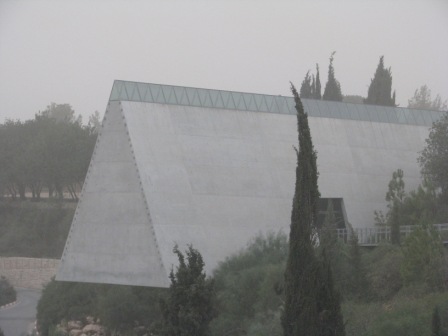
Yad Va Shem (the stirring memorial and museum of the Holocaust) is a 20 minute city bus ride across town in the modern city.  It is hard to imagine how to best treat the subject matter, but this complex does justice to both the history and commemoration.  The museum is an extended A-frame concrete spartan structure (designed by Moshe Safde of Habitat Expo 67 fame – for a Canuck connection), with a chronological view of events in smaller side rooms.  From the rise of the Nazi party, through the second world war events, concentration camp details (and compelling survivor accounts), through to explore the lesser known post war events (i.e. first world refusals of refugees, displaced orphans, circuitous routes of migration to Israel).  Beyond the museum building itself are various memorials to resistance fighters, no longer existent European communities and maybe the most impactful, a separate building containing a large dark glass maze with reflecting omni-directional memorial candles and an ominous voice performing roll call of all the children killed in the holocaust.


Our entry into Israel was 5 days earlier via the southern port of Eilat, an Israeli resort getaway with desert and seaside activities, which at the time of our arrival was hopping for the last two days of Chanukah.


It was Menorah mayhem, with the ubiquitous candelabra showing up everywhere (behind the immigration officer at the border, attached to the top of a cab, at major highway intersections, in mall, hotel and bus station lobbies (it was like Christmas – uh, oh, that may cost some points back home).


Climb Every Mountain - alternatively "Sunrise, Sunset" (Egypt)

Our 45 minute flight from Luxor to the Sinai resort community of Sharm El Sheik was actually 10 minutes early, and the transfer van to our destination of Dahab was on time – it was like clockwork.
  • Fast forward 10 minutes:  Highway checkpoint. Van after van stop, driver exit and interact with no less than 7 officials.  Documents are registered by hand in hard bound books, drivers return and vans continue en route.  Our driver is nowhere to be seen.
  • 25 minutes later: Our driver returns and we turn back (driving against traffic on the wrong side of the highway).  Driver suggests all is fine – 5 more minutes and we’ll be off.
  • 15 minutes later: We transfer to another van driven by original driver’s brother for return attempt at checkpoint – success.  But 1 km past checkpoint we stop, park on the highway shoulder and shut engine and lights.
  • 10 minutes later: Original van (somehow having passed through the checkpoint this time) parks alongside and we transfer back again to resume transport.

Quite a system - seems secure, efficient and foolproof, in no way arbitrary, random or haphazard.  While many international businesses are focused on assisting developing nations with automated processes, there may be more money in securing the Egyptian ledger and carbon paper concession.


Surrounded by stretches of smooth sandy seashore, the Sinai sprawls with spans of steep stone spires and skree (the best of my eight alliterative tongue twister attempts).   Dahab is a bit of a backpacker haven (in contrast to the luxury resorts of “Sharm”); about half way up the east side of the peninsula.  The beach promenade is stuffed with restaurants, shops, bars and dive shacks (diving and snorkeling are the big draw here – after chilling).  Oddly, all the normal Egyptian conservative trappings (characteristic of a Muslim nation) have been discarded in favour of conventional tourism, as evidenced by the patios full of scantily clad foreigners chugging back beer and cocktails (possibly a spillover from Israeli rule after gaining the area in the 1973 Yom Kippur War – ceded back to Egypt in the early ‘80s).


Even the dogs chill in Dahab

The area’s other big attraction is the hike up nearby Mt. Sinai (famed as the location where Moses saw the Burning Bush and received the Ten Commandments).  There are two trek options:  a day hike timed to reach the peak at sunset; or the idiotic choice we made – commencing the climb at 1 am intending to summit at sunrise.  What an ill conceived plan – no sleep, walking uphill in the dark desert, ending with 750 steep steps, all accompanied with 1500 other “pilgrims”.  Who can tell the difference between sunrise and sunset anyway – it’s just a matter of the background being East vs. West (you guys will never know from the photo).  By the way, the hike must be guided in a group - ours comprised a half dozen Chinese tourists and a Korean girl.  It kind of reminded me of a Winter Olympic speed skating final – and you’ll be glad to know we did our country proud leaving them in our “proverbial” dust.

Can you tell!

Who's idea was this?

The "alleged" Burning Bush

The flamboyant description of the country in the Egyptair in-flight magazine opines that: “she is beautiful, stunning, charming, amazing [and] fully aware of her beauty…”, but seemingly unaware of a remaining plague.  Save for one day of wicked wind off the Gulf of Aqaba, we had no respite from the onslaught of common house flies.  In Egypt, these insipid insects don’t just congregating near the most proximate pile of dung or refuse, they’re everywhere, come in droves and there is no escape.

After two days of recovery (from the climb), it was time to attempt the land border crossing from Egypt to Israel (there can’t be any remnant plagues there?).


Note: Additional Egypt photos at:

http://www.flickr.com/photos/thegoobers_pics/sets/72157625681693959/

Total Pageviews